
Ten Principles for Digital Creators Discussing Psychology Online
Psychology has become one of the most frequently used – and simultaneously misused – topics in the public sphere. As a result, the scale of oversimplification and misinformation is growing, which can have a real impact on the quality of mental health care.

On social media, in podcasts, TV programs, and online guides, content related to emotions, relationships, professional burnout, or self-development appears almost daily. The growing interest in mental health is a socially important phenomenon, but along with it, the scale of oversimplification and misinformation regarding psychology is also increasing.
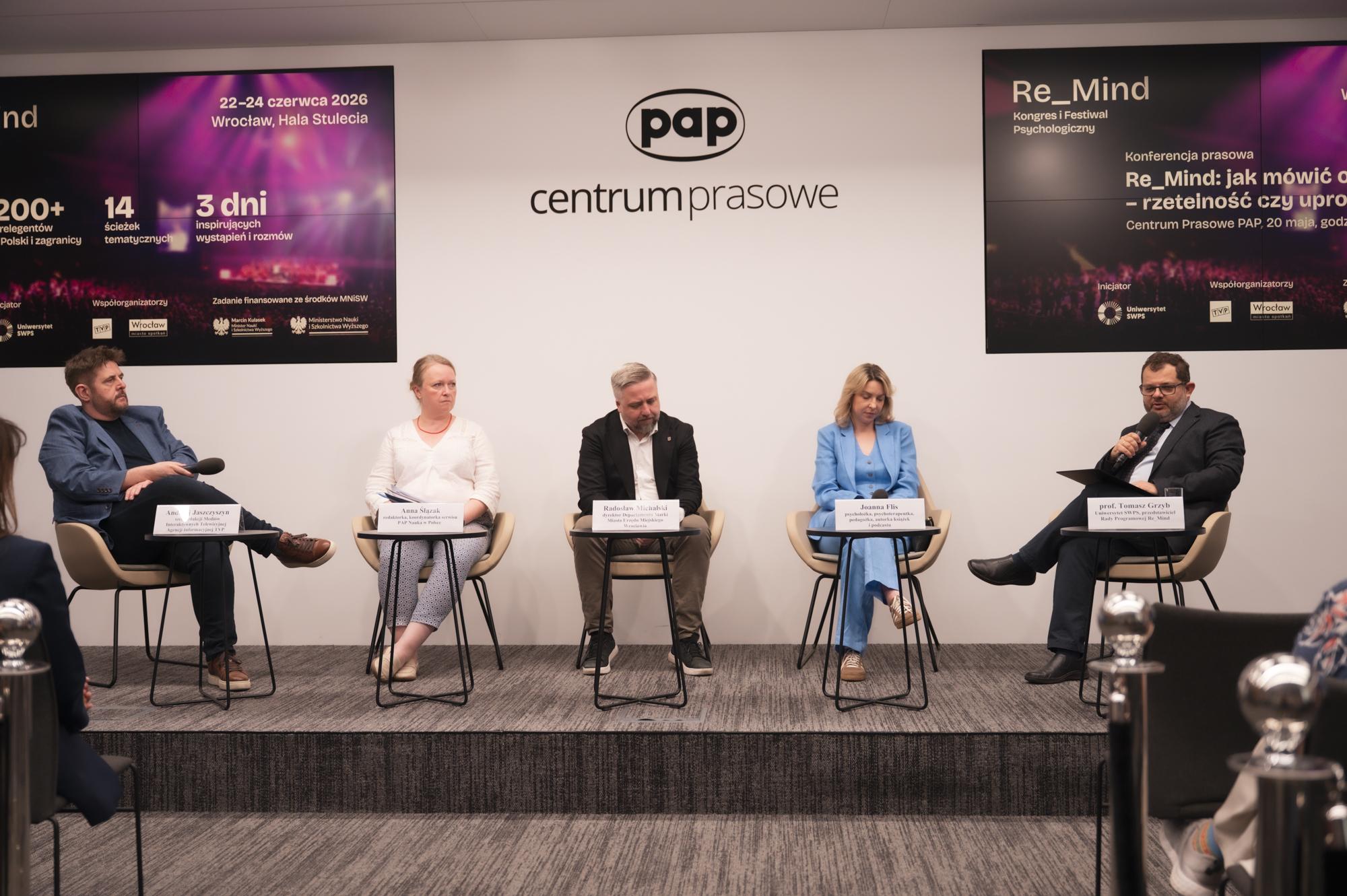
In response to these phenomena, Re_Mind initiator – SWPS University – and event co-organizers the City of Wrocław and Telewizja Polska, together with digital creators gathered around the Re_Mind initiative, are launching a debate on the quality and standards of psychological communication.
Responsible communication about mental health
SWPS University, together with digital creators who are part of the Re_Mind Digital Creators Council, have prepared a proposal for "Ten Principles for Digital Creators Discussing Psychology Online". The initiative aims to highlight the importance of responsibly popularizing psychological knowledge and the role of reliable communication in building public awareness. The debate on this topic will continue during the Re_Mind Psychological Congress and Festival – the first event of its kind in Poland, aimed at both individuals caring for their well-being and practitioners: psychologists, psychotherapists, leaders, managers, educators, creative professionals, as well as internet creators, media professionals, and journalists who want to discuss psychology in an engaging yet responsible and scientifically informed manner.
The interest in psychology and the presence of mental health topics in the media show how much society today needs knowledge that helps understand oneself and others. This is a very important and necessary change, but at the same time, we observe that oversimplifications, superficial interpretations, and content not based on scientific knowledge are increasingly appearing in the public sphere. Therefore, we want to create a space for discussion on how to responsibly communicate psychology and how to build access to reliable knowledge - say the Re_Mind Initiators, Professor Roman Cieślak, Rector of SWPS University, and Dr. Ewa Ger, General Director of SWPS University

Among those involved in preparing the recommendations were digital creators, gathered around the Re_Mind Digital Creators Council initiative and specializing in psychology topics:
- Janina Bąk, widely known as Janina Daily,
- Patrycja Czajkowska, an internet creator, widely known as patrycjaczyja,
- Joanna Flis, psychologist, psychotherapist, author, and podcaster,
- Joanna Gutral, psychologist, creator of the Gutral Gada podcast,
- creators of Tutaj Podcast – Robert Konecki and Mateusz Kowalski,
- Monika Kotlarek – creator of the PsychologiaNaCoDzien podcast,
- Maciej Krawczyk – YouTuber, creator of the Zmiana Doświadczania channel,
- Justyna Nagłowska, podcast creator, including: A Mother is Human Too, Nagłowska Out Loud, A Man is Human Too,
- Paulina Urbanowicz, known as urbann.psyche,
- Jerzy Zieliński – editor-in-chief of pewnaterapia.pl magazine and creator of the zielinskijerzypl channel.
- Ewa Zimmermann – a YouTuber known for the PsychoLoszka channel.
– We are all drowning in a thicket of pseudoscience and oversimplifications that seemingly make our lives better, but in practice, the effect is quite the opposite. Discussing psychology requires deep reflection, responsibility, and an awareness of how to convey this knowledge. Psychoeducation's primary purpose is to increase the likelihood of seeking support and decrease the likelihood of independently solving one's own complex mental health problems. These principles seem to me to be a good guide for everyone who wants to genuinely implement psychoeducation in the digital space. – says Joanna Flis, psychologist, podcaster, author, and one of the creators on the Re_Mind Digital Creators Council.
Red flags: 100% promises, quick diagnoses, and "life hacks"
Short formats, rapid information flow, and the pressure for attractive content mean that psychological topics are often presented in an oversimplified, decontextualized, or overly sensational manner. This is precisely why the discussion about the responsibility of those communicating psychology in the public sphere has become so important today.
Among the "Ten Principles for Digital Creators Discussing Psychology Online" These include, among others, the necessity of basing communication on scientific knowledge and research findings, avoiding presenting individual studies as undeniable truth, and clearly separating facts from personal interpretations. The authors of the recommendations also emphasize that psychology does not provide simple answers to all questions, which is why responsible communication should take into account research limitations and the complexity of human experiences. The importance of respect for the audience was also highlighted, as well as avoiding messages based solely on emotions, sensationalism, or oversimplifications aimed at increasing reach. The creators of the guidelines also drew attention to the need for continuous knowledge updates and openness to development.
– Digital creators can do a lot of good in the context of mental health and expanding knowledge about human beings. They can help their audiences understand the complexity of the social world. However, the condition is responsible communication, conducted in accordance with the current state of knowledge. – says Prof. Dr. hab. Tomasz Grzyb from SWPS University, member of the Program Council of the Re_Mind Psychological Congress and Festival.
The recommendations also include practical tips for verifying psychological knowledge. The creators encourage checking whether a given claim is supported by scientific research, whether the results have been replicated in various analyses, and whether the authors openly discuss limitations. The authors of the recommendations also emphasize that content presented as quick "life hacks" or universal solutions should be viewed with caution.
Attention was drawn to phenomena that can serve as warning signs for audiences. The most common "red flags" include promises of "100% effectiveness," narratives suggesting that a given method "works for everyone," a lack of references to specific research, or the use of terms devoid of real meaning. The authors also warn against overly simplistic explanations of complex phenomena and online "diagnoses" that can mislead audiences.